Configure Multi-Recipient Checkout: Order & Shipping Settings
Set up order processing, recipient fields, and shipping options for multi-recipient checkout on your Shopify store.
The multi-recipient checkout settings page in Send To Many lets you control how orders are created, what information shoppers provide, and how shipping works. You'll find these settings under Multi-recipient checkout in your app settings, organized into tabs along the left side.
This article covers the core settings most merchants configure first: order processing, recipient fields, and shipping and delivery options. For additional form fields, inquiries, upsell discounts, shipping rate filters, and advanced settings, see Configuring Checkout: More Options.
Order Processing
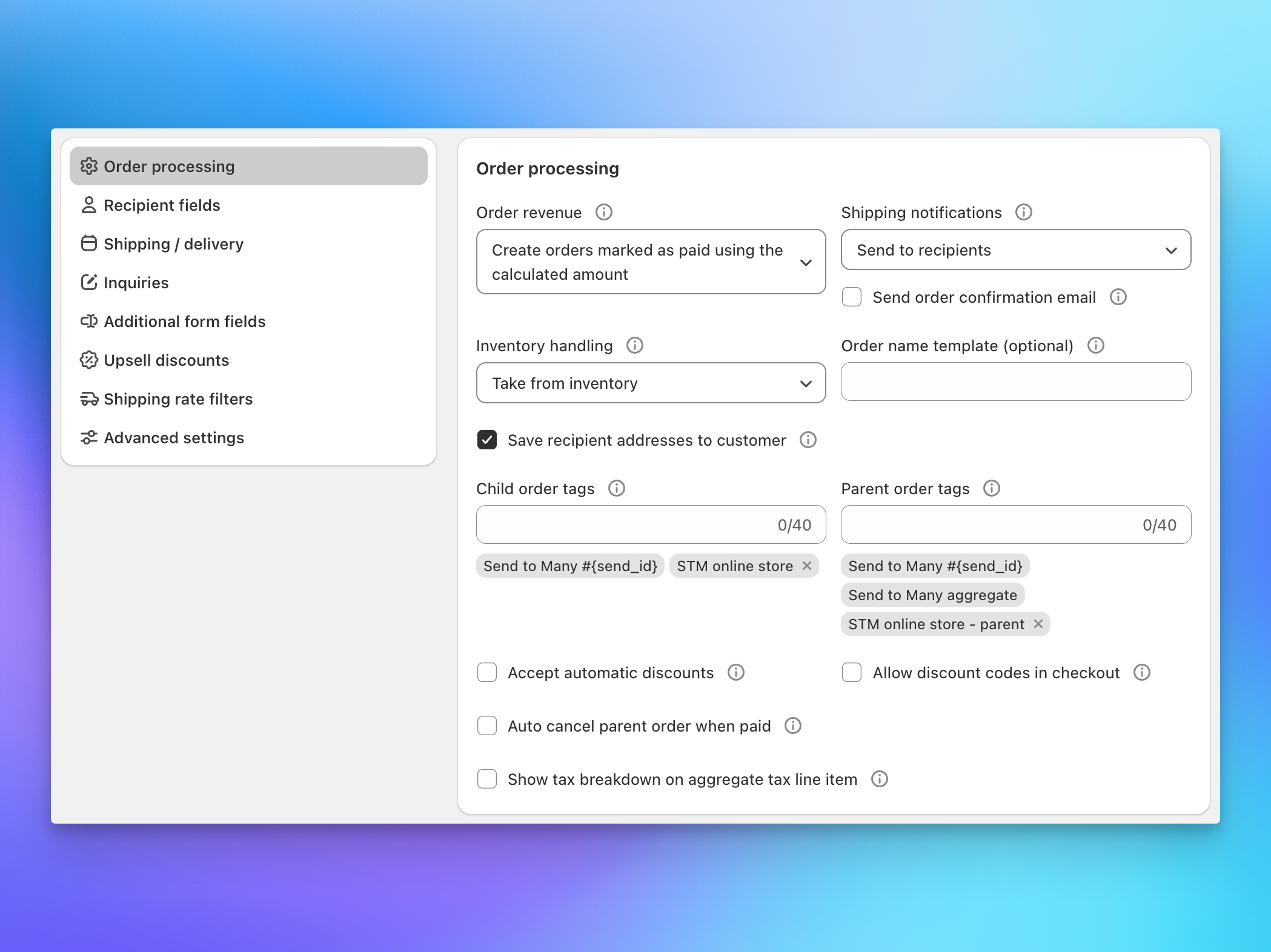
The order processing tab controls how recipient orders are created in Shopify after a shopper completes checkout.
Order Revenue
Choose how revenue appears on recipient (child) orders:
- Create orders marked as paid using the calculated amount: Each recipient order shows the full calculated price, tax, and shipping. Use this when you need per-order revenue detail for accounting or tax reporting.
- Create orders marked as paid with $0 amounts: Recipient orders are created at $0. All revenue is captured on the gifter (parent) order only. This avoids double-counting revenue in Shopify reports.
This is the most important configuration choice for checkout. If you use calculated amounts, revenue appears on both the gifter order and each recipient order, which means Shopify reports will double-count unless you filter by order tags. If you use $0 amounts, revenue is only on the gifter order, but you won't see per-recipient pricing detail on child orders. We recommend discussing this with your accounting team before going live.
Shipping Notifications
Control who receives Shopify's order confirmation and shipping notification emails:
- Suppress notifications: No emails are sent. Orders use a blackhole email address (suppressed+...@sendtomany.com) so Shopify's automatic notifications go nowhere. This is the right choice for most gifting use cases where you don't want recipients getting order confirmation emails.
- Send to recipients: Shopify sends order and shipping notifications directly to the recipient's email address.
- Send to customer: Notifications go to the gifter (the person who placed the order).
If you choose to send notifications to the customer, the gifter may receive 3 or 4 shipping emails for each recipient in the order. For a 50-recipient send, that's up to 200 emails.
Send order confirmation email: An additional toggle that controls whether Shopify's order confirmation email is sent (separate from delivery/shipping notifications).
Inventory Handling
- Take from inventory: Deducts inventory for each recipient order. Standard for most use cases.
- Don't take from inventory: Skips inventory deduction on recipient orders. Use this if you're managing inventory manually or through another system.
Save Recipient Addresses to Customer
When enabled, each recipient's shipping address is added to the gifter's Shopify customer record. This makes addresses available for future orders but can result in many addresses on a single customer profile. Disable this if your gifters regularly send to large recipient lists.
Order Name Template
Customize how recipient orders are named in Shopify. Leave blank to use Shopify's default sequential naming. You can include dynamic variables to make order names more descriptive.
Child Order Tags and Parent Order Tags
Apply Shopify tags to recipient orders and the gifter order, respectively. Tags are useful for filtering orders in Shopify, triggering Shopify Flow automations, and routing orders to fulfillment services. Enter tags and press Enter to add them. We add some tags by default. Those can't be removed.
Additional Options
- Accept automatic discounts: When enabled, Shopify's automatic discounts apply to checkout orders.
- Allow discount codes in checkout: Lets shoppers enter discount codes during the multi-recipient checkout flow.
- Auto cancel parent order when paid: Automatically cancels the gifter (parent) order after payment is collected and recipient orders are generated. Useful if you don't want the parent order appearing in your fulfillment queue.
- Show tax breakdown on aggregate tax line item: Displays a detailed tax breakdown on the gifter order's aggregate tax line item instead of a single lump sum.
Recipient Fields
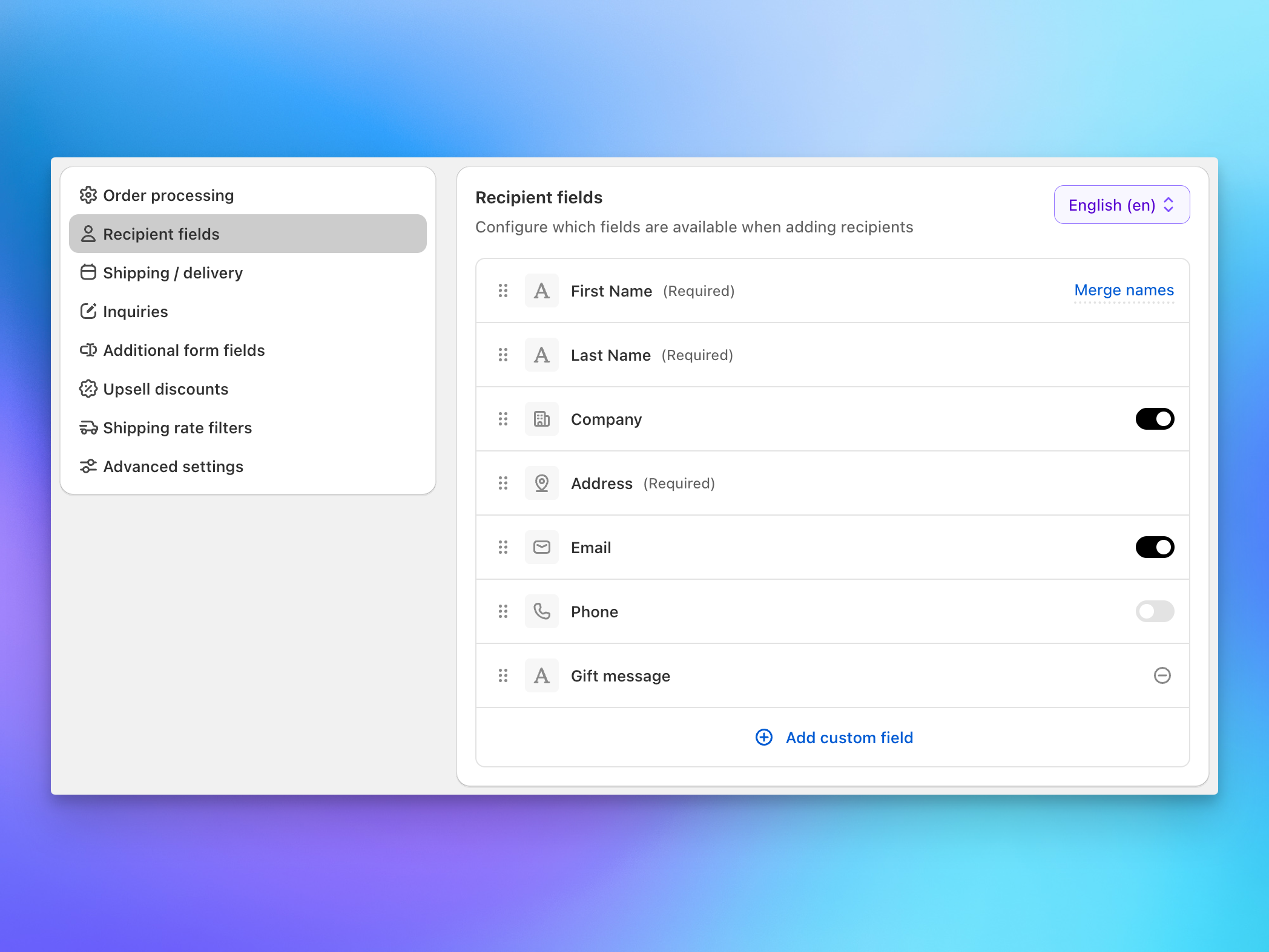
Configure which fields are available when shoppers add recipients. You can reorder fields by dragging, toggle them on or off, and edit each field's settings.
Default Fields
- Name Fields: Always required. You can choose whether to use a single name field or split the field into First and Last Name fields.
- Company: Optional. Toggle on to show a company name field.
- Address: Always required. Uses Google address autocomplete for fast, accurate entry.
- Email: Toggle on to collect recipient email addresses. We'll apply basic email validation to this field.
- Phone: Toggle on to collect recipient phone numbers. We'll validate based on your store's locale settings.
Shipping Date Picker
Depending on your app wide Shipping settings and the Shipping / delivery selections in this checkout section, you may also see a shipping date field in the recipient fields. Options will include:
- Label: The field label (e.g., "Shipping date").
- Required: Whether a shipping date must be selected.
- Can fill down: Lets shoppers set one date and apply it to all recipients.
For full shipping date configuration including date ranges, blackout dates, and format settings, see Shipping and delivery options below.
Custom Fields
Click Add custom field to create additional per-recipient fields beyond the defaults. Options include text, number, date, dropdown, checkbox, multi-select, etc fields.
For instance, a Gift Message field would use a text field formatted as follows:
- Label: The field label shown to shoppers (e.g., "Gift message").
- Placeholder: Placeholder text inside the input.
- Multiline: Enable for multi-line text input (recommended for gift messages).
- Show character count: Display a character counter as shoppers type.
- Max character limit: Set a maximum character count.
- Field type: Where the message is stored on the order: "Order additional detail" or "Note attribute."
- Key: The key used to store the value (e.g.,
_gift_message). Keys starting with an underscore are hidden from the customer-facing order status page. - Required: Whether the field is mandatory.
- Can fill down: Lets shoppers set a value on the first recipient and apply it to all others.
Language Support
If you have added another language in the Text and Translations settings, you'll see a the language dropdown (top right) to configure field labels for recipient fields.
Shipping and Delivery Options
Send To Many calculates shipping separately for each recipient based on their location and the products they're receiving. You configure the shipping behavior in the Shipping / delivery tab in your multi-recipient checkout settings and, for rate sources, on the Shipping & delivery rates page in your main app settings.
Shipping and Delivery Rate Sources
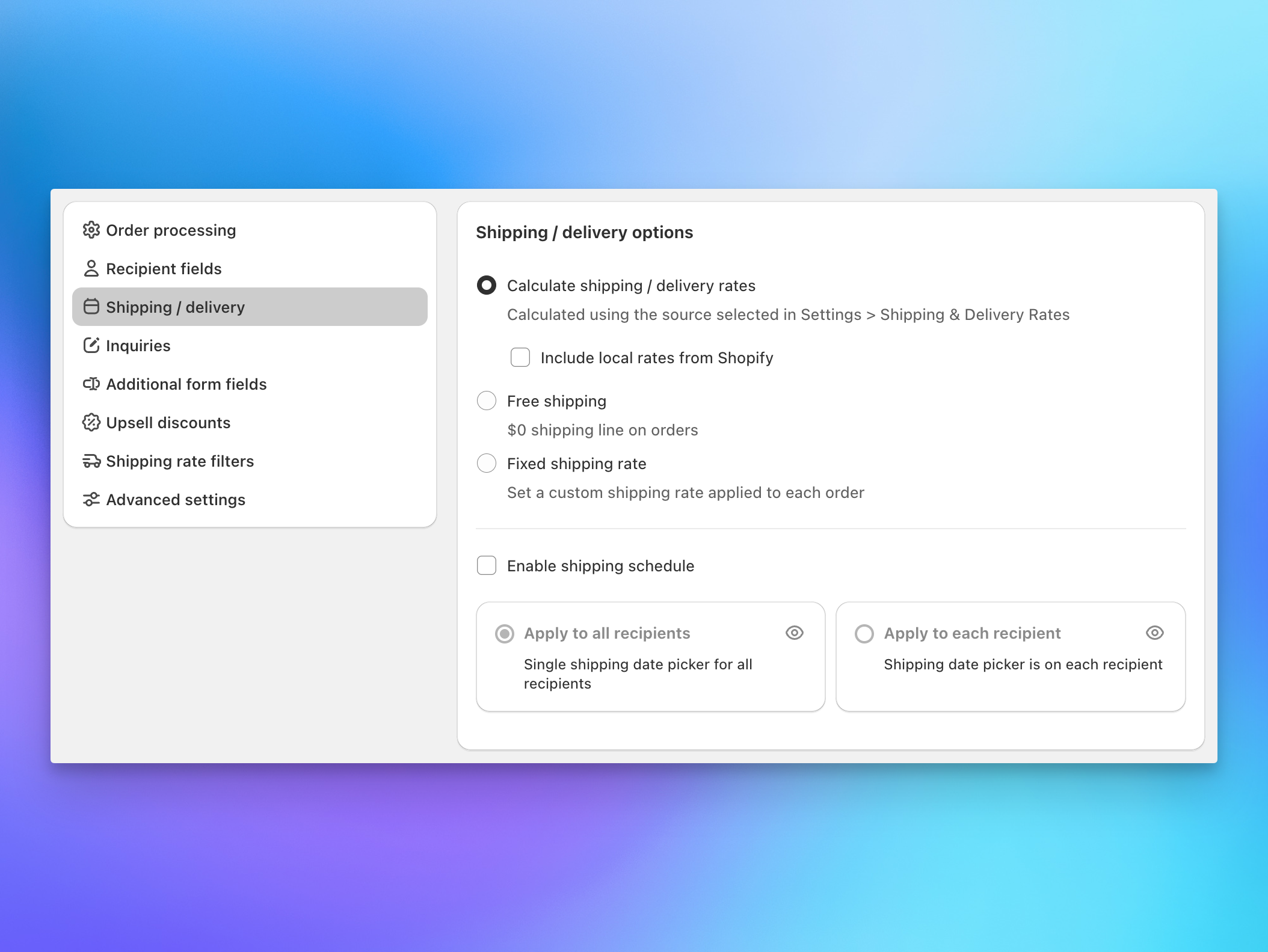
Choose how shipping rates are determined for each recipient order:
- Calculate shipping / delivery rates: Uses your configured rate source (Shopify shipping settings, Bird, Zapiet, or a custom integration) to calculate per-recipient rates. Shoppers see available rates and select one during checkout. This is the most common option.
- Include local rates from Shopify: An additional toggle available when using calculated rates. Enables local delivery and pickup rates from Shopify alongside standard shipping rates.
- Free shipping: Sets a $0 shipping line on all recipient orders. No rate selection shown to shoppers.
- Fixed shipping rate: Applies a custom flat rate to each recipient order. You set the rate amount when selecting this option.
Shipping Schedule
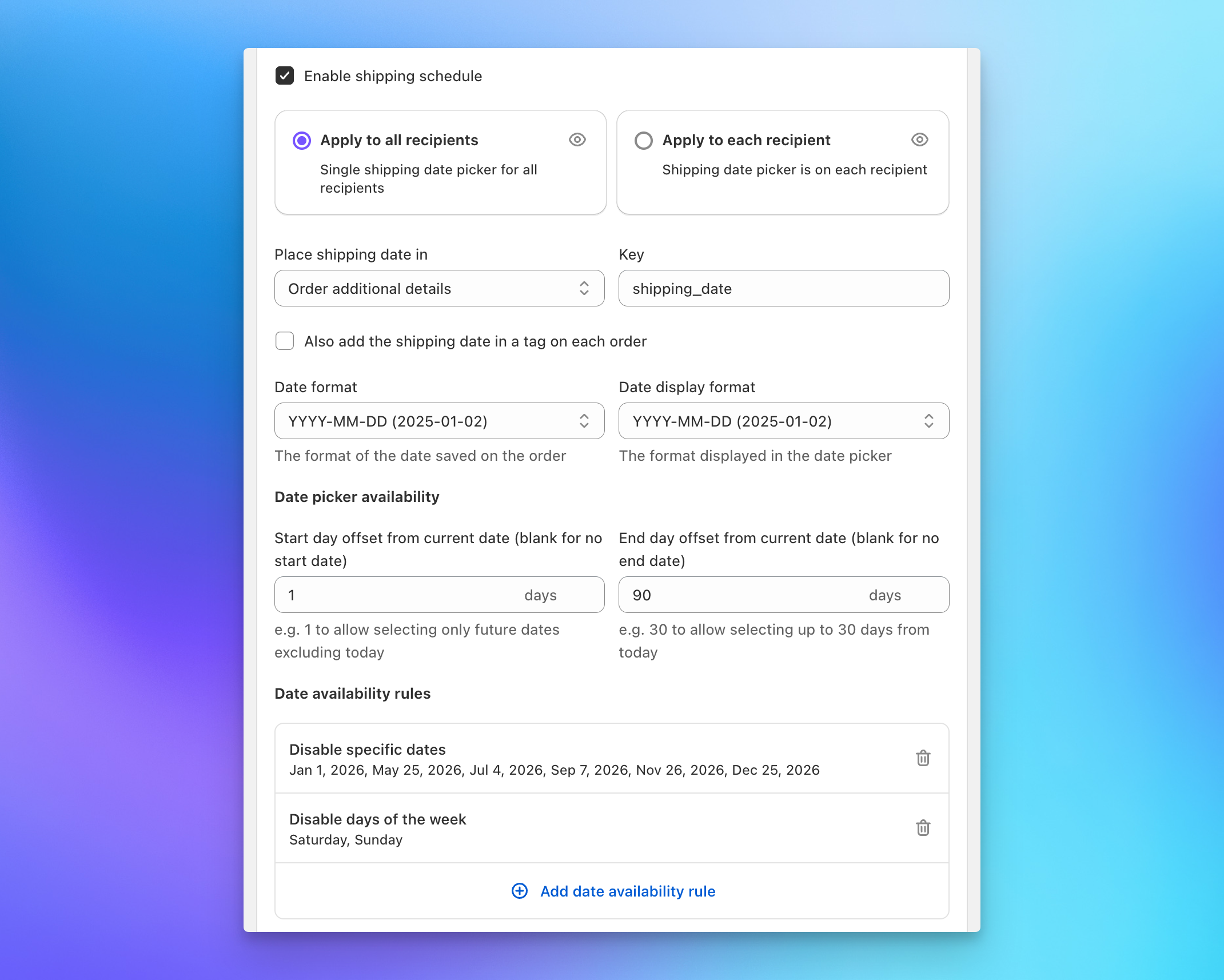
When you enable the shipping schedule, a date picker appears on the checkout form so shoppers can select delivery dates.
Date Picker Mode
- Apply to all recipients: A single date picker appears once, and the selected date applies to every recipient in the order.
- Apply to each recipient: A date picker appears on each recipient's entry form. Each recipient can have a different shipping date.
Date Storage
Configure where the selected shipping date is stored on each order:
- Place shipping date in: Choose "Order additional details" or "Note attributes" as the storage location on the Shopify order.
- Key: The key used to store the value (e.g.,
shipping_date). This is what you'll use to find the date in Shopify order data. - Also add the shipping date in a tag on each order: Optionally adds the selected date as an order tag for easy filtering in Shopify.
Date Formats
- Date format: The format used to save the date on the order (e.g.,
YYYY-MM-DD). This is the machine-readable format stored in order data. - Date display format: The format shown to shoppers in the date picker (e.g.,
YYYY-MM-DD). You can make this more human-readable if needed.
Date Picker Availability
Control which dates are available for selection:
- Start day offset from current date: The earliest selectable date, expressed as days from today. For example,
1means shoppers can select starting from tomorrow. Leave blank for no start restriction. - End day offset from current date: The latest selectable date, expressed as days from today. For example,
30means shoppers can select up to 30 days out. Leave blank for no end restriction.
Date Availability Rules
Add rules to disable specific dates or patterns:
- Disable specific dates: Block individual dates (e.g.,
Jan 1, 2026for a holiday). Click Add date availability rule to add one. - Disable days of the week: Block recurring days (e.g., every Sunday). Useful for businesses that don't ship on weekends.
You can add multiple rules.
Next Steps
- Configuring Checkout: More Options: Additional form fields, inquiries, upsell discounts, and advanced settings
- Adding multi-recipient checkout to your Shopify theme: Install the checkout on your storefront
- Customizing checkout appearance with CSS: Match the checkout to your store's branding